The efforts of the Sandhers to clean up an apparent spill this summer are suspicous.
 | The manner of chemicals moving through that distribution point means severe pollution could be washing into Sandher ditches.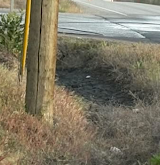 | Ditches around the Sandher plant are burnt and lifeless. |
|
 | The first thing one notices at the Sandher Crime Family plant at 3231 Old Vernon Road are what appear chemical trails. For comparison, the also Sinaloa Cartel funded plant of the cousin Gills at 3201 Pooley Road show no such chemical trails on the roadway.
Whatever is passing through the Sandher plant is not passing through the Gill's plant.
|  |
__________________________
The "Logistics Chain" Strategy
 | This structure allows the organization to separate the high-risk "cook" phase from the high-volume "import" phase. Sandher Fruit Packers serves as the critical entry point for chemical shipments in the Okanagan. The facility provides the necessary industrial footprint and heavy-machinery infrastructure to receive large shipping containers. The facility operates as a 24-hour logistical hub, which aligns with the need for non-standard delivery times for sensitive chemical cargo. The high-volume nature of the packing plant (handling millions of pounds of fruit) makes it an ideal "front" for importing specialized reagents like Pinacolyl Alcohol and Thionyl Chloride. |
Pinacolyl alcohol (3,3-dimethyl-2-butanol) is a flammable liquid and a known chemical irritant. It presents significant acute health risks, including toxicity if inhaled, swallowed, or absorbed through the skin. Thionyl chloride (SOCl₂) is a highly reactive inorganic compound widely used as a chlorinating agent in organic synthesis. It is extremely hazardous, fuming, and toxic, requiring rigorous safety protocols. Phosphorus trichloride (PCl₃) is a highly corrosive, colorless fuming liquid used as a crucial chemical intermediate. It reacts violently with water, releasing clouds of hydrogen chloride gas and phosphoric acid. It requires strict handling protocols.
 | The Transit and Production Network. The route from the Kelowna hub leads north into the North Okanagan and Columbia-Shuswap regions, where rural isolation provides a shield for storage and manufacturing. The storage node was Enderby. Properties identified by the RCMP CLEAR team as massive staging grounds were for for chemical precursors. In late 2024, investigators discovered 30,000 kilograms of chemicals at a rural site here, which police confirmed were destined for high-capacity labs. The Production Node was Falkland. The location housed what the RCMP described as the "largest and most sophisticated" clandestine superlab in Canadian history. The site at 5011 Hoath Road was capable of producing massive quantities of fentanyl and methamphetamine, directly utilizing the chemicals funneled through the Enderby and Kelowna pipeline. |
The short distance (40-60 minutes) between these nodes allows the organization to move precursors quickly in response to "cook" schedules while keeping the primary chemical stock away from the final lab site to minimize total loss during a single raid.
 | The discovery of Phosphorus Trichloride (PCl3) in Enderby is the final, definitive chemical marker for the production of both nerve agents and high-purity synthetic drugs. While PCl3 is used in the manufacture of the herbicide Roundup, its presence alongside the other chemicals (Pinacolyl Alcohol and Thionyl Chloride) creates a "Chemical Profile" that is incompatible with legitimate fruit farming. |
 | PCl3 is the fundamental starting material for the world’s most lethal chemical weapons. PCl3 is reacted with a methylating agent to create Methylphosphonous Dichloride. This is the "Universal Precursor" for the entire G-series of nerve agents, including Sarin and Soman. Once they have the methylphosphonous dichloride, they use the Pinacolyl Alcohol and Thionyl Chloride (found on-site) to complete the synthesis of Soman.
In clandestine drug labs, PCl3 is used as a highly efficient chlorinating agent and reagent. It is used to convert primary and secondary alcohols into the alkyl chlorides needed for fentanyl synthesis. When combined with Sodium Borohydride (the "Finisher"), PCl3 allows a lab to reach nearly 100% purity. In the world of $1-billion trafficking, the difference between 90% and 99% purity is worth tens of millions.
|
The Sandhers will likely claim the PCl3 is for making their own pesticides or herbicides to save costs. That is rubbish. Modern fruit packers do not manufacture their own glyphosate (Roundup) from raw PCl3. It is a complex, dangerous, and highly regulated industrial process that requires a dedicated chemical plant, not a fruit-packing hangar. PCl3 reacts violently with water to release clouds of Hydrogen Chloride gas and phosphoric acid. Keeping this near a "fruit wash" line is equivalent to keeping a live hand grenade in a kitchen.
 | CBSA and the RCMP have identified a sophisticated methodology used by the Sandhers to import "Dual-Use" chemicals. The Sandhers' ability to bring in substances like Phosphorus Trichloride and Thionyl Chloride relies on exploiting the gap between legitimate industrial needs and clandestine drug production. The primary way these chemicals enter is by being "mis-manifested" or correctly identified but falsely justified. |
Until very recently, many of these chemicals were not "prohibited" but "regulated." Under the Chemical Weapons Convention (CWC), businesses with industrial licenses can import them as long as they provide an "End-Use Certificate". The Sandhers use their decades long reputation as a major BC fruit exporter to bypass the scrutiny that a new or unknown company would face.
__________________________
Trade-Based Money Laundering - TBML
The Integrated Money Laundering Intelligence Partnership is investigating how companies use "over-invoicing" and "under-invoicing" to hide chemical purchases.
 | By paying for the chemicals via the Sandher Family Trust in Australia, the financial trail never touches a Canadian bank until the product is already at the Kelowna facility. The "Chemical Middler" is a third-party intermediary who sets up a physical or online storefront to appear as a legitimate chemical distributor. This middler buys the PCl3 from a major supplier in China or India and "resells" it to the Sandhers, masking the true source and destination from border agents. |
The CBSA uses 'Risk-Based Targeting'. Because Sandher Fruit Packers is a "low-risk" exporter of cherries and apples, their incoming containers are often subjected to less frequent "secondary inspections" than shipments from unknown industrial importers. In a facility that handles millions of pounds of fruit, 20 drums of chemicals can be easily hidden at the back of a reefer (refrigerated container) under a layer of legitimate packing supplies like plastic flumes or bulk fertilizers.
The use of defamation lawsuits as a "shield" for high-level criminal organizations is well-documented. These are often referred to as SLAPPs (Strategic Lawsuits Against Public Participation). Criminals use defamation law to protect their reputation from attacks, weaponizing the legal system to silence investigators, bloggers, and witnesses before a criminal indictment can be unsealed.
 | High-level criminals (and their corporate "fronts") use these suits not necessarily to win on the merits, but to achieve three tactical goals: 1) chilling effect - to scare others (journalists, neighbors, or whistleblowers) into silence by showing that speaking out leads to immediate, ruinous legal costs. 2) Discovery Suppression - to tie up a critic in civil court, where "rules of evidence" can be used to prevent them from digging deeper into sensitive areas like chemical procurement or offshore trusts. 3) Reputation Laundering - A "win" in a defamation case (especially a Default Judgment where the defendant flees) is used as a PR tool to tell banks and regulators, "Look, a judge called these allegations vitriol". |
The relationship between the Sandhers and Ryan Wedding is no longer a secret "partnership of convenience" — it is a volatile liability that has entered a "terminal phase." Historically, the Sandhers provided Wedding with what he needed most; plausible deniability and logistical cover. Wedding relied on "enablers" (like lawyer Deepak Paradkar and jeweler Rolan Sokolovski) to move money. The Sandhers' financial channels are "glowing red" under audit. In high-level Drug Trafficking Organizations (DTOs), "clean-skin" facilitators like the Sandhers are often the first to be sacrificed to protect the "Kingpin." Wedding and will likely argue that the Sandhers were the "masterminds" of the Canadian operation, leaving the family to face the same life sentence he faces. At last report the death sentence was still on the Wedding table.


